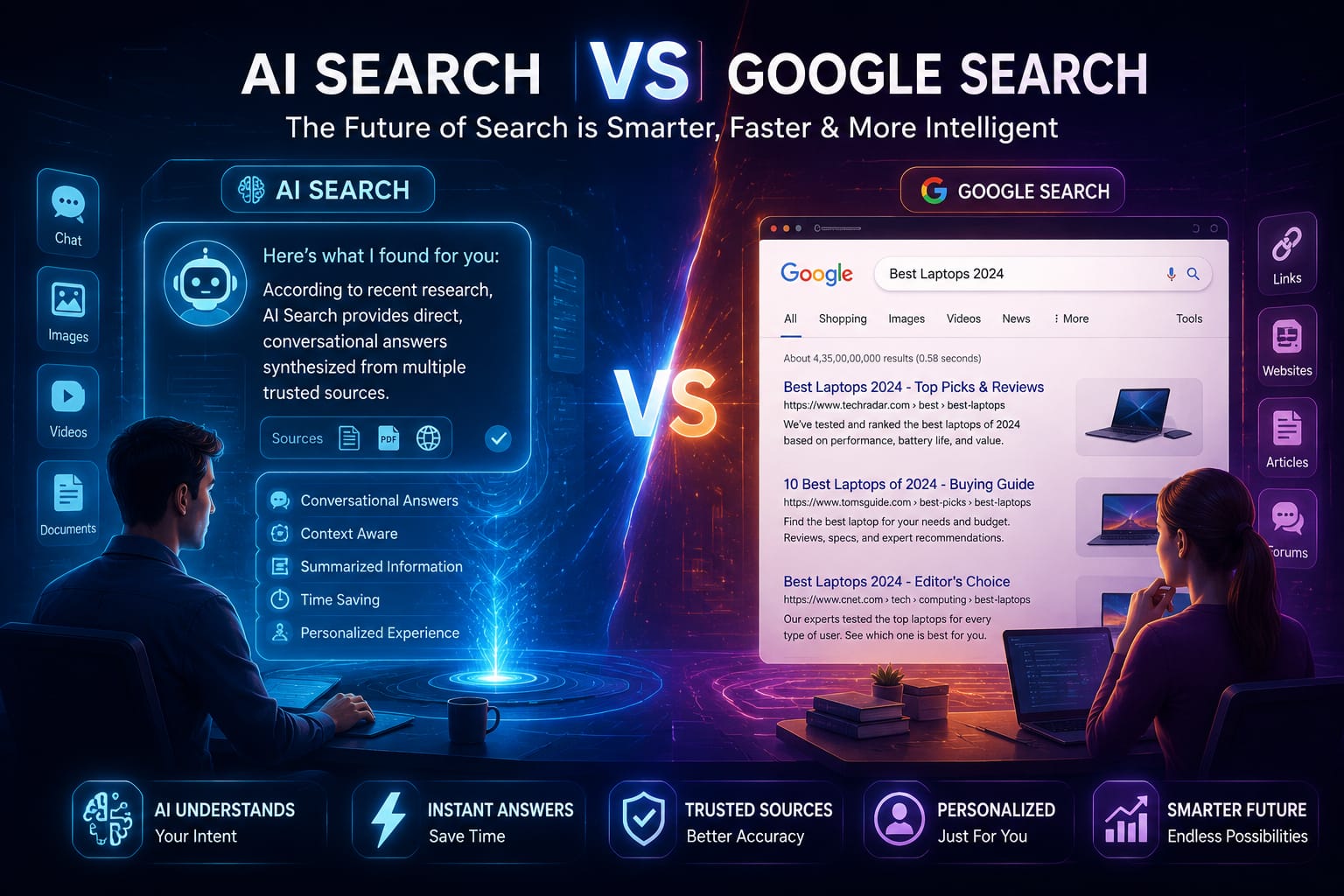
The way people search for information online has changed dramatically over the years. Not long ago, finding answers on the internet meant typing a few keywords into a search engine and browsing through multiple websites until the required information was found. Today, things are changing rapidly. Artificial intelligence is introducing a new way of discovering information, making search more conversational, personalized, and interactive than ever before.
For decades, Google Search has been the dominant gateway to the internet. Whether someone wants to learn a new skill, compare products, read reviews, solve technical problems, or research an important topic, Google has been the first destination for billions of users worldwide.
However, the rise of AI-powered search tools has started a new conversation. Instead of displaying a list of websites, AI search systems can provide direct answers, summaries, recommendations, and explanations within seconds.
As a result, many users are asking an important question:
The debate around AI Search vs Google Search is becoming increasingly important as users look for faster and more accurate ways to find information online.
Is AI Search better than Google Search?
The answer depends on how you use the internet and what kind of information you’re looking for.
In this comprehensive comparison, we’ll explore the differences between AI Search and Google Search, their strengths, weaknesses, and why both technologies are likely to play an important role in the future of online information discovery.
Understanding the Evolution of Search
Before comparing AI Search and Google Search, it’s important to understand how internet search has evolved.
In the early days of the internet, search engines were relatively simple. They primarily relied on keywords to match user queries with web pages.
As the internet expanded, search engines became more sophisticated. Google introduced advanced ranking systems that considered factors such as:
- Content quality
- Website authority
- User experience
- Backlinks
- Relevance
These improvements helped users find better information faster.
Today, artificial intelligence is creating the next major evolution in search technology.
Instead of simply matching keywords, AI systems attempt to understand user intent, context, and meaning.
This shift is changing how people interact with information online.
What Is Google Search?
Google Search is a web search engine that helps users discover information across billions of web pages.
Understanding AI Search vs Google Search starts with understanding how traditional search engines organize and deliver information.
When someone enters a search query, Google performs several tasks almost instantly:
Crawling
Google continuously scans websites across the internet.
Indexing
Information from websites is stored and organized.
Ranking
Google evaluates content using hundreds of ranking signals.
Displaying Results
The most relevant pages are shown to users.
This process has made Google one of the most successful technology platforms ever created.
One of Google’s greatest strengths is its ability to connect users directly with original sources.
Instead of providing a single answer, Google offers multiple perspectives and resources.
This allows users to verify information independently.
Why Google Search Became So Popular
Google became successful because it solved a major problem.
The internet contains an enormous amount of information.
Without search engines, finding relevant content would be extremely difficult.
Google provides:
- Fast results
- Reliable indexing
- High-quality rankings
- Access to original sources
- Broad content discovery
These advantages continue to make Google Search an essential tool for internet users.
Even today, billions of searches are performed daily because people trust Google’s ability to find relevant information.
The continuing AI Search vs Google Search discussion shows that users still value reliable access to original information sources.
What Is AI Search?
AI Search represents a new approach to information discovery.
Unlike traditional search engines, AI Search focuses on generating answers rather than simply displaying links.
When users ask a question, AI systems analyze the request, understand the context, retrieve relevant information, and generate a conversational response.
This creates an experience that feels more like talking to an expert than using a search engine.
For example:
If someone asks:
“What are the advantages of cloud storage for small businesses?”
Google Search may display articles discussing cloud storage.
An AI Search tool may immediately provide a concise explanation highlighting:
- Cost savings
- Scalability
- Accessibility
- Security improvements
- Collaboration benefits
This ability to summarize information quickly is one reason AI Search is gaining popularity.
When comparing AI Search vs Google Search, one of the biggest differences is how information is presented to users.
Many users now rely on AI assistants for brainstorming ideas, creating content, learning new concepts, and improving productivity.
How AI Search Works
AI Search relies on several advanced technologies.
The AI Search vs Google Search comparison becomes clearer when examining how AI systems process and generate answers.
AI systems use large language models and advanced machine learning techniques to understand user intent and generate responses.
Natural Language Processing
This allows AI systems to understand human language more effectively.
Machine Learning
AI models learn patterns from large amounts of information.
Context Recognition
The system attempts to understand what users actually mean.
Conversational Memory
Many AI platforms remember previous questions during a conversation.
Information Synthesis
Instead of showing multiple sources separately, AI combines information into a single response.
These capabilities create a more interactive search experience.
Advanced AI models can now analyze images, audio, videos, and written content simultaneously, helping them provide more accurate and context-aware responses.
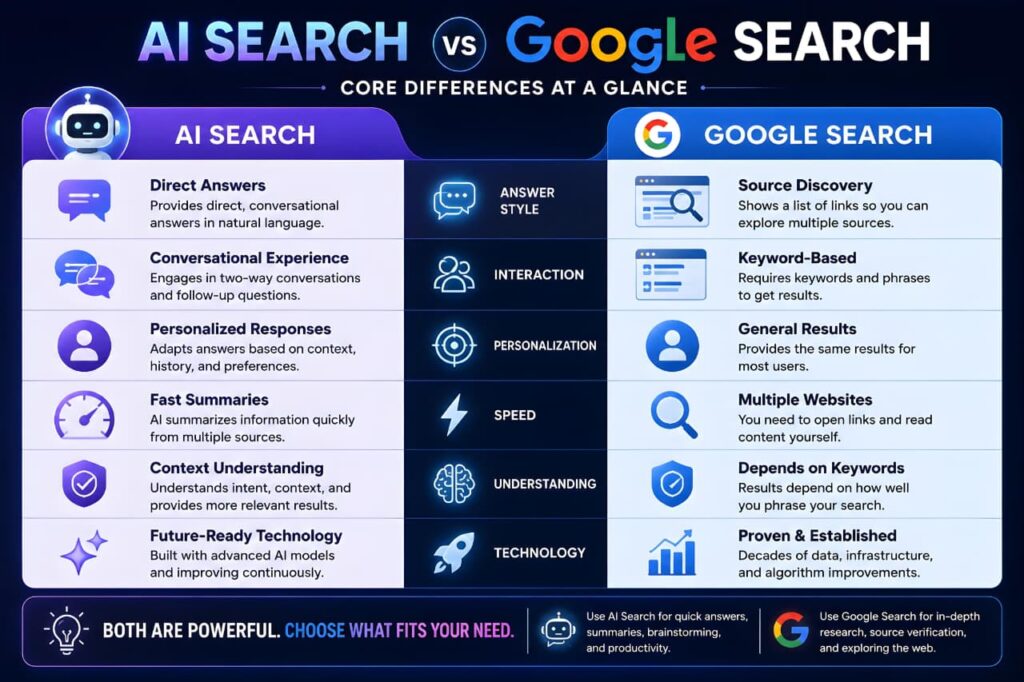
AI Search vs Google Search: Core Differences
Although both technologies help users find information, they operate in very different ways.
The core AI Search vs Google Search differences can significantly impact the way users discover and consume information.
Information Delivery
Google Search provides links.
AI Search provides answers.
User Interaction
Google relies on searches and clicks.
AI Search relies on conversations.
Research Process
Google encourages exploration.
AI Search emphasizes efficiency.
Content Discovery
Google helps users discover websites.
AI Search helps users understand topics quickly.
Follow-Up Questions
AI Search supports natural conversations.
Google often requires additional searches.
These differences significantly impact how users interact with information.
When AI Search Is Better
There are many situations where AI Search offers clear advantages.
Many users prefer AI Search vs Google Search for quick explanations because AI can summarize complex topics instantly.
Quick Explanations
Many users simply want an answer.
Instead of opening multiple websites, AI Search can provide a summary immediately.
Examples include:
- Definitions
- Concepts
- Comparisons
- Tutorials
- General knowledge
This saves time and improves convenience.
Learning New Topics
Students and professionals frequently use AI tools to understand unfamiliar subjects.
AI can explain:
- Technical concepts
- Scientific topics
- Business terminology
- Software tools
in a simple and accessible way.
This makes learning more efficient.
Brainstorming and Idea Generation
AI Search is particularly useful for creative tasks.
Users can generate:
- Content ideas
- Marketing strategies
- Blog outlines
- Business concepts
- Research topics
within seconds.
For readers interested in AI-powered assistants that support productivity and learning:
Productivity and Workflow Support
Modern AI systems can assist users with:
- Summarizing content
- Drafting documents
- Organizing information
- Creating action plans
- Simplifying complex topics
This makes AI Search especially valuable for professionals, students, marketers, and content creators.
The popularity of AI search has increased significantly because many users now depend on conversational AI platforms to generate content ideas, learn new concepts, solve problems, and improve productivity.
Why Users Are Increasingly Choosing AI Search
Several factors contribute to the growing popularity of AI Search.
This growing trend has made the AI Search vs Google Search comparison more relevant than ever before.
Faster Results
Users often receive answers immediately.
Simplified Information
Complex topics become easier to understand.
Personalized Experience
AI adapts to the conversation.
Reduced Information Overload
Instead of reviewing dozens of pages, users receive concise summaries.
Better Accessibility
People with limited technical knowledge can understand complicated topics more easily.
These advantages explain why AI-powered search experiences continue to attract new users.
The Rise of AI-Powered Search Platforms
The growing popularity of AI Search has encouraged technology companies to invest heavily in artificial intelligence.
Search is no longer just about finding information.
It is becoming about understanding information.
Many modern platforms are integrating AI directly into their search experiences.
This trend suggests that future search systems may become more intelligent, conversational, and context-aware.
As AI search technology continues to evolve, users are increasingly comparing different AI platforms to understand which solution offers better accuracy and overall search experience.
Why This Comparison Matters
The debate around AI Search vs Google Search is about more than technology.
It reflects a broader shift in how people interact with information.
Traditional search engines were designed to help users find content.
AI Search systems are designed to help users understand content.
Both approaches solve important problems.
The real question isn’t which technology will win.
The real question is how users can benefit from both.
When Google Search Is Better
While AI Search offers impressive capabilities, Google Search continues to excel in several important areas.
In the AI Search vs Google Search discussion, Google still remains a strong choice for source verification and in-depth research.
Finding Original Sources
One of Google’s biggest advantages is source discovery.
When conducting serious research, users often need access to:
- Official websites
- Government publications
- Academic studies
- Research papers
- Industry reports
Google makes it easy to locate these original sources directly.
This is especially important when accuracy and verification matter.
Product Research and Reviews
Before purchasing a product, many users prefer comparing multiple reviews.
Google Search allows users to:
- Read expert reviews
- Compare specifications
- View customer opinions
- Watch video reviews
This broader perspective often leads to better purchasing decisions.
Local Search
Google remains one of the strongest platforms for local information.
Users frequently search for:
- Restaurants
- Hotels
- Hospitals
- Stores
- Directions
- Business reviews
Google’s integration with maps and local listings gives it a major advantage in this area.
Breaking News and Current Events
When major events happen, Google Search often provides access to multiple news sources.
Users can compare different perspectives and evaluate information independently.
This makes Google highly valuable for staying informed about developing stories.
AI Search vs Google Search: Accuracy Comparison
Accuracy remains one of the most important factors when evaluating AI Search vs Google Search.
Google's Strength
Google provides access to source material.
Users can:
- Read original content
- Compare sources
- Verify information
- Evaluate credibility
This transparency helps reduce misinformation.
AI Search Challenges
AI systems can sometimes:
- Misinterpret questions
- Oversimplify topics
- Miss important context
- Generate inaccurate responses
Although AI technology continues to improve, users should still verify important information.
This is especially true for:
- Medical advice
- Legal information
- Financial decisions
- Business planning
In these situations, original sources remain essential.
The Biggest Limitations of AI Search
AI Search offers many benefits, but it isn’t perfect.
Limited Source Visibility
Users may not always know where information originated.
This can make verification more difficult.
Hallucinations
AI systems occasionally generate incorrect information that appears convincing.
This remains one of the biggest challenges facing AI-powered search.
Dependence on Available Data
AI systems can only work with the information they have access to.
If information is incomplete or outdated, results may be affected.
Privacy Concerns
Many users are concerned about how AI systems collect and process data.
Privacy remains an important consideration for future AI development.
Understanding these limitations is essential when evaluating AI Search vs Google Search for everyday use.
The Biggest Limitations of Google Search
Google Search also has challenges.
Information Overload
A single search may produce millions of results.
Finding the best answer can take time.
SEO Manipulation
Some websites focus more on ranking than providing value.
This can occasionally affect search quality.
Time Consumption
Users often need to:
- Open multiple pages
- Compare information
- Read lengthy articles
before finding what they need.
This is one reason AI Search has become attractive.
These challenges are one reason why the AI Search vs Google Search debate continues to evolve.
The Future of Search Technology
Search technology is evolving rapidly.
The future is unlikely to involve AI Search replacing Google Search entirely.
Instead, both systems are likely to influence each other.
The future of AI Search vs Google Search will likely involve a combination of conversational AI and traditional search engines.
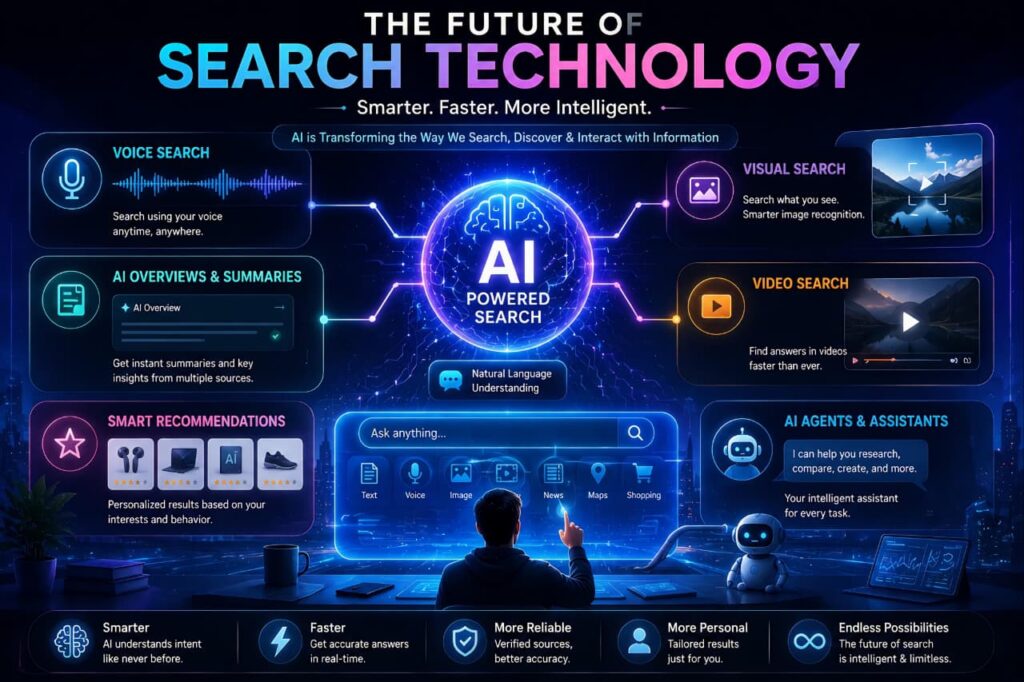
Future search experiences may include:
- Direct AI-generated answers
- Verified source citations
- Personalized recommendations
- Voice-based interactions
- Visual search capabilities
- Context-aware conversations
This combination could provide a more efficient search experience.
Future search systems may go far beyond providing answers by helping users complete tasks, make decisions, and automate complex workflows with minimal human involvement.
The future of search is expected to combine artificial intelligence with traditional information retrieval systems.
The Rise of Intelligent Search Systems
Search technology is moving beyond simple information retrieval.
Future systems may help users:
- Complete tasks
- Make decisions
- Organize information
- Automate workflows
These intelligent systems are often referred to as AI agents.
Unlike traditional search engines, AI agents focus on achieving goals rather than simply providing information.
As competition grows, the AI Search vs Google Search landscape is expected to change significantly over the coming years.
How AI Tools Are Expanding Search Capabilities
Modern AI tools are transforming the way people work with information.
Today’s AI-powered platforms can assist with:
- Writing
- Research
- Coding
- Image generation
- Data analysis
- Productivity
These tools are expanding what users expect from search technology.
The growing AI ecosystem now includes solutions that can assist with writing, image generation, workflow automation, data analysis, and numerous other productivity-related tasks.
AI Search vs Google Search: Which One Should You Use?
The answer depends on your goals.
Use AI Search When You Need:
- Quick explanations
- Summaries
- Brainstorming
- Learning support
- Productivity assistance
Use Google Search When You Need:
- Original sources
- Research materials
- Product reviews
- Local information
- Current news
The most effective approach is often using both.
Many users now begin with AI Search to understand a topic and then use Google Search to verify information and explore sources.
This combination offers the best balance between convenience and accuracy.
Choosing the right AI assistant depends on factors such as accuracy, speed, features, and overall user experience.
Real-World Example
Imagine you’re researching cloud storage.
Using Google Search
You may:
- Search the topic.
- Open several articles.
- Compare information.
- Read product reviews.
- Visit company websites.
Using AI Search
You may:
- Ask a question.
- Receive a summary.
- Ask follow-up questions.
- Understand the topic faster.
Both approaches provide value.
The choice depends on how much depth and verification you require.
This example clearly demonstrates how AI Search vs Google Search can serve different user needs and research goals.
Frequently Asked Questions
Many common questions about AI Search vs Google Search focus on accuracy, speed, and overall user experience.
What is the main difference between AI Search and Google Search?
Google Search provides links to websites, while AI Search generates direct answers and explanations.
Is AI Search more accurate than Google Search?
Not necessarily. AI Search can provide helpful summaries, but Google Search allows users to verify information directly from original sources.
Can AI Search replace Google Search?
AI Search may reduce reliance on traditional search for certain tasks, but Google Search remains important for research, discovery, and verification.
Why are more people using AI Search?
Users appreciate:
- Faster answers
- Simpler explanations
- Conversational interactions
- Improved productivity
Which is better for students?
Both can be useful.
AI Search helps students understand concepts quickly, while Google Search helps them access academic and educational sources.
Which is better for content creators?
Many content creators use both.
AI Search helps generate ideas and summaries, while Google Search helps with research and source verification.
Final Thoughts
The debate surrounding AI Search vs Google Search isn’t about choosing a winner.
Both technologies solve different problems.
Google Search remains one of the most powerful tools for discovering information, exploring websites, and verifying sources. Its ability to connect users directly with content creators and original content continues to make it indispensable.
AI Search, on the other hand, offers a faster, more conversational, and more user-friendly way to understand information. It simplifies complex topics, reduces research time, and helps users learn more efficiently.
The future of search will likely combine the strengths of both approaches.
Users will benefit from AI-generated insights while maintaining access to trusted sources through traditional search engines.
Rather than competing against each other, AI Search and Google Search are likely to work together to create a smarter, faster, and more effective online information experience.
As technology continues to evolve, the most successful users will be those who understand how to leverage both tools effectively.
Ultimately, the AI Search vs Google Search comparison is not about choosing a winner but understanding when each tool is most effective.