Artificial intelligence has become a part of everyday life. Millions of people use AI tools to search for information, write content, generate images, summarize documents, solve problems, and improve productivity. While these tools are incredibly powerful, they are not always accurate.
One of the biggest challenges associated with modern AI systems is a phenomenon known as What Is AI Hallucination.
If you have ever used ChatGPT, Google Gemini, or another AI assistant and received an answer that sounded convincing but turned out to be completely wrong, you may have encountered an AI hallucination.
AI hallucinations can affect students, professionals, researchers, businesses, and content creators. In some cases, they may simply produce harmless mistakes. In other situations, they can lead to misinformation, poor decision-making, financial losses, or credibility issues.
Understanding What Is AI Hallucination is becoming increasingly important as AI-generated content continues to spread across websites, search engines, social media platforms, and productivity tools.
In this guide, you’ll learn what AI hallucinations are, why they happen, real-world examples, and practical ways to reduce their impact.
What Is AI Hallucination?
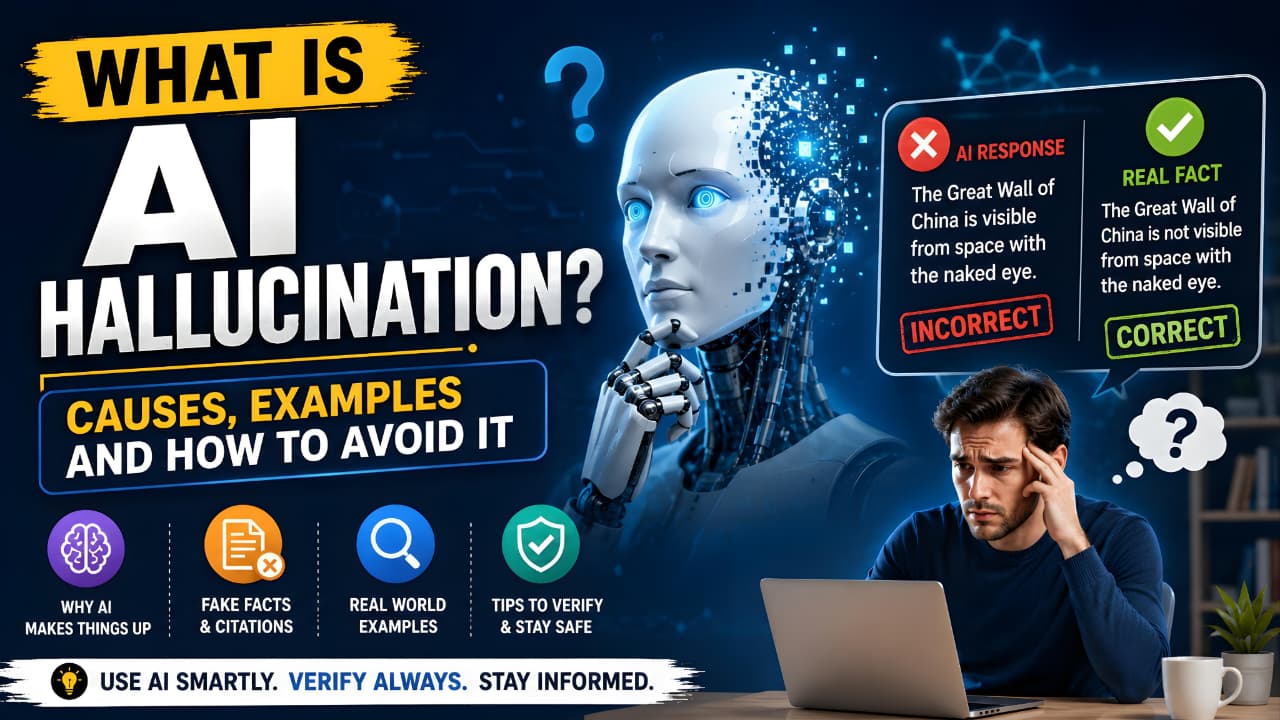
AI Hallucination refers to a situation where an artificial intelligence system generates information that appears accurate and convincing but is actually incorrect, misleading, fabricated, or unsupported by reliable evidence.
Unlike humans, AI models do not truly understand information the way people do. Instead, they predict the most likely sequence of words based on patterns learned during training.
As a result, AI systems sometimes generate:
- Incorrect facts
- Non-existent references
- Fake statistics
- Fabricated quotes
- Imaginary research papers
- Wrong dates
- False citations
- Misleading explanations
The most concerning aspect of AI hallucinations is that the answers often sound highly confident, making them difficult to identify.
For example:
A user asks: “Who won a specific award in a year when that award did not exist?”
An AI system might still provide a detailed answer instead of admitting uncertainty.
This is a classic example of What Is AI Hallucination in practice.
Why Is Understanding AI Hallucination Important?
As AI becomes more integrated into daily workflows, understanding What Is AI Hallucination becomes essential.
Today, people rely on AI for:
- Research
- Content creation
- Education
- Business planning
- Coding assistance
- Customer support
- Decision-making
When AI provides incorrect information, users may unknowingly trust and share it.
This creates risks such as:
- Spreading misinformation
- Publishing inaccurate content
- Making poor business decisions
- Academic integrity issues
- Damaged credibility
For content creators, understanding AI limitations is just as important as understanding AI capabilities. Readers interested in learning more about the strengths and weaknesses of modern AI systems should explore ChatGPT Explained: Uses, Benefits and Limitations, which covers how AI models generate responses and where their limitations become apparent.
Why Do AI Hallucinations Happen?
One of the most common questions people ask after learning What Is AI Hallucination is:
“Why does AI make things up?”
The answer lies in how large language models work.
AI systems do not search the internet like humans do every time they answer a question.
Instead, they generate responses by predicting patterns based on training data.
Several factors contribute to hallucinations.
1. Predictive Language Generation
AI models are prediction engines.
They attempt to generate the most likely next word based on context.
Sometimes the model lacks sufficient information but still tries to produce an answer.
Instead of saying: “I don’t know.”
The model may generate a plausible but incorrect response.
2. Incomplete Training Data
AI systems learn from enormous datasets, but no dataset contains every fact, event, document, or scenario.
Knowledge gaps can result in:
- Missing information
- Incorrect assumptions
- Fabricated details
When this happens, hallucinations become more likely.
3. Ambiguous User Prompts
Vague or unclear questions can increase the chances of hallucination.
For example: “Tell me about the most important AI breakthrough.”
This question lacks context.
Different AI systems may interpret it differently and provide inconsistent answers.
Providing specific prompts generally improves response quality.
4. Lack of Real Understanding
Despite their impressive capabilities, AI systems do not possess genuine understanding or consciousness.
They recognize patterns.
They do not independently verify facts.
This limitation is one of the primary reasons What Is AI Hallucination remains an important topic in artificial intelligence research.
Common Types of AI Hallucinations
Not all hallucinations are the same.
Understanding the different categories can help users identify them more effectively.
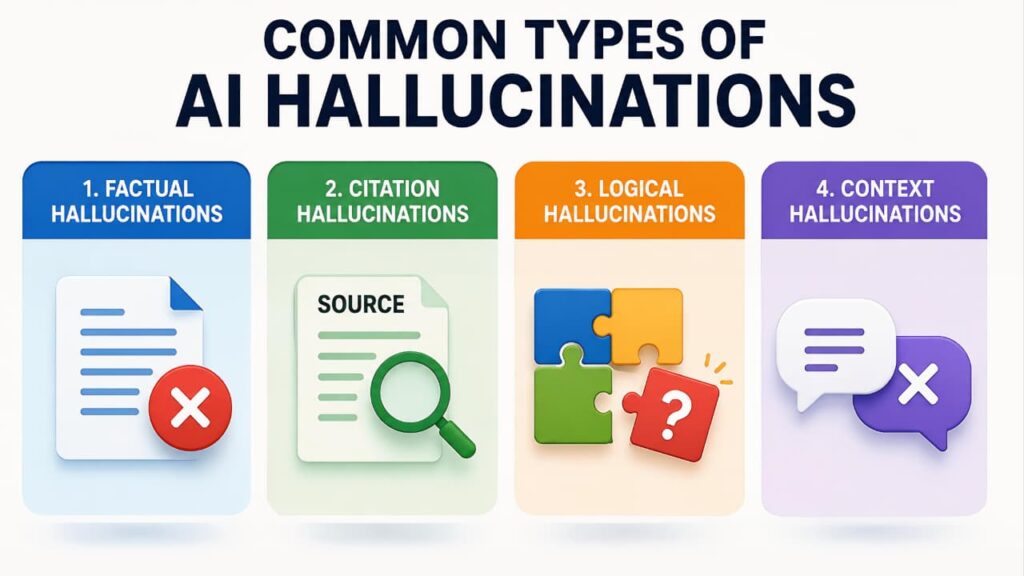
Factual Hallucinations
These occur when AI presents incorrect facts as truth.
Examples:
- Wrong dates
- Incorrect names
- False historical information
- Misreported statistics
Citation Hallucinations
AI may invent:
- Academic papers
- Research studies
- Author names
- Scientific references
The citation appears real but does not actually exist.
This is one of the most dangerous forms of AI hallucination in educational and research settings.
Logical Hallucinations
Sometimes facts may appear correct individually but become illogical when combined.
Example:
The AI may correctly describe two events but incorrectly claim they occurred in the wrong sequence.
Context Hallucinations
These occur when AI misunderstands the user’s intent and generates responses that do not match the intended context.
Real Examples of AI Hallucination
Understanding real-world examples makes What Is AI Hallucination easier to recognize.
Example 1: Fake Legal Cases
In one widely discussed incident, AI-generated legal research included court cases that did not actually exist.
The citations looked legitimate.
The case names appeared professional.
However, the cases were completely fabricated.
This example demonstrated how dangerous AI hallucinations can become when information is not independently verified.
Example 2: Incorrect Historical Facts
Users occasionally ask AI tools about historical events.
While many responses are accurate, AI may sometimes:
- Provide incorrect dates
- Misidentify individuals
- Invent historical details
Because the answers sound authoritative, users may not immediately notice the mistakes.
Example 3: Fabricated Sources
Researchers have reported cases where AI systems generated:
- Non-existent books
- Fake journal articles
- Imaginary publications
This is why experts recommend verifying all citations provided by AI.
AI Hallucination in ChatGPT
Many users searching for What Is AI Hallucination are specifically interested in ChatGPT.
ChatGPT is one of the most widely used AI assistants in the world.
While it performs exceptionally well in many tasks, it can still generate hallucinations under certain conditions.
Common examples include:
- Incorrect references
- Outdated information
- Invented statistics
- Misinterpreted prompts
Understanding these limitations helps users apply appropriate fact-checking methods.
People comparing AI assistants often notice differences in response quality. Exploring Google Gemini vs ChatGPT can help readers understand how different AI systems approach information generation and why hallucination rates may vary depending on the task.
AI Hallucination in Google Gemini
Google Gemini also experiences hallucinations from time to time.
Like other large language models, Gemini generates responses based on learned patterns rather than guaranteed factual verification.
Hallucinations may occur when:
- Information is incomplete
- Queries are ambiguous
- Sources contain conflicting data
- The model lacks sufficient context
This challenge affects nearly all modern AI systems and remains a major focus of ongoing AI research.
Risks of AI Hallucination
Understanding What Is AI Hallucination is only the first step. The next important question is:
“What happens when AI hallucinations go unnoticed?”
The answer depends on how the information is being used.
In some situations, hallucinations may cause minor confusion. In other cases, they can lead to serious consequences.
Misinformation
One of the biggest risks is the spread of misinformation.
When AI generates incorrect facts, users may:
- Share false information
- Publish inaccurate articles
- Reference non-existent sources
- Make incorrect assumptions
Since AI-generated responses often sound convincing, many users fail to verify the information before sharing it.
Academic Problems
Students increasingly use AI tools for research and assignments.
However, AI hallucinations can cause:
- Incorrect citations
- Fake references
- Wrong historical facts
- Misleading explanations
Submitting unverified AI-generated information may negatively affect academic performance.
Students using AI for research should understand both the benefits and limitations of AI-powered learning tools. Exploring Free AI Tools for Students can help users choose tools responsibly while maintaining proper verification practices.
Business Risks
Businesses often use AI for:
- Market research
- Customer support
- Content creation
- Strategic planning
Hallucinated information can result in:
- Poor business decisions
- Reputation damage
- Customer trust issues
- Financial losses
This is why human review remains essential.
Content Quality Problems
Many content creators now use AI-assisted writing tools.
While these tools can improve productivity, publishing unverified AI-generated information can reduce content quality.
Google increasingly rewards content that demonstrates:
- Experience
- Expertise
- Authority
- Trustworthiness
These principles are often referred to as E-E-A-T.
Writers using AI should focus on fact-checking rather than blindly accepting generated responses.
How AI Hallucinations Affect Content Creators
For bloggers and website owners, understanding What Is AI Hallucination is especially important.
AI-generated content can save time, but it also introduces risks.
Common issues include:
Publishing Incorrect Information
An AI tool may generate:
- Wrong product details
- Incorrect dates
- False technical explanations
If published without verification, these mistakes can harm credibility.
SEO Challenges
Search engines prioritize helpful and accurate content.
Articles containing hallucinated information may:
- Reduce user trust
- Increase bounce rates
- Generate negative feedback
- Hurt long-term SEO performance
Understanding the differences between AI-generated answers and traditional search methods can help creators evaluate information more effectively. Readers interested in this topic should explore AI Search vs Google Search for a deeper understanding of how AI-powered information retrieval works.
How to Verify AI-Generated Information
One of the best defenses against hallucinations is verification.
Whenever AI provides important information, users should confirm its accuracy independently.
Here are some proven methods.
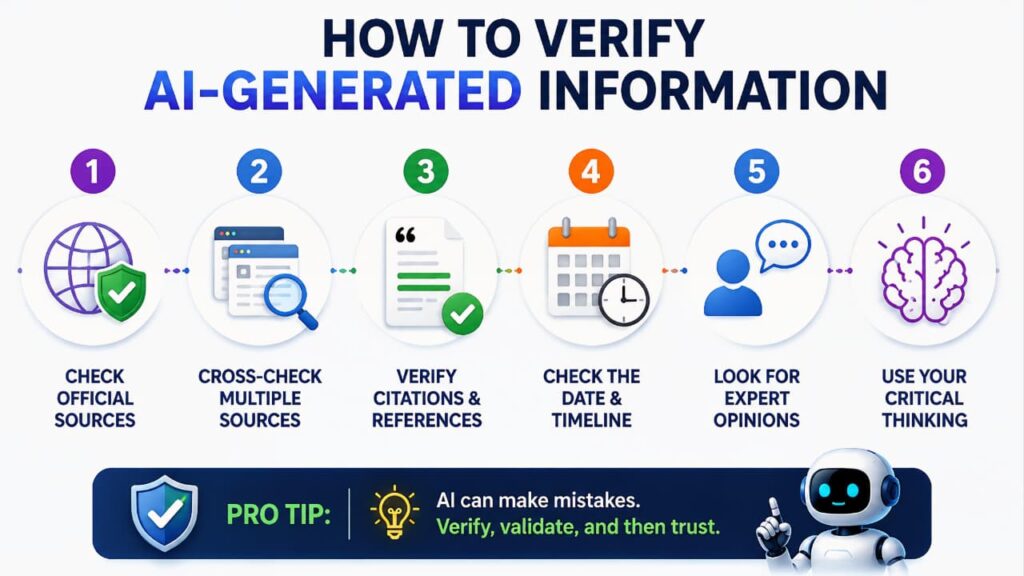
Check Official Sources
Always verify critical information using:
- Official company websites
- Government portals
- Academic institutions
- Official documentation
Official sources are generally more reliable than AI-generated summaries.
According to Google AI, AI-generated responses should be treated as helpful assistance rather than guaranteed factual truth, especially for important decisions.
Cross-Check Multiple Sources
Never rely on a single source.
Compare information across:
- Multiple websites
- Industry publications
- Government resources
- Expert analyses
If several trustworthy sources confirm the same information, confidence increases significantly.
Verify Citations
If an AI system provides:
- Research papers
- Academic references
- Books
- Reports
Verify that these sources actually exist.
Citation hallucinations remain one of the most common AI-related problems.
Ask Follow-Up Questions
Users can often reduce hallucinations by asking:
- “Can you provide sources?”
- “How confident are you?”
- “Is this information verified?”
- “What evidence supports this claim?”
Additional context often improves response quality.
How to Avoid AI Hallucination
While hallucinations cannot be eliminated completely, they can often be reduced.
Understanding What Is AI Hallucination helps users develop better habits when interacting with AI systems.
Use Specific Prompts
Instead of asking: Tell me about AI.
Try: Explain the causes of AI hallucination in large language models.
Specific prompts reduce ambiguity and improve accuracy.
Request Sources
Whenever possible, ask AI systems to provide:
- References
- Documentation
- Supporting evidence
Then verify those sources independently.
Verify Important Information
Never rely solely on AI for:
- Medical advice
- Legal advice
- Financial decisions
- Academic citations
Always confirm critical information using authoritative sources.
Keep Human Oversight
AI works best as an assistant rather than a replacement for human judgment.
Human review helps identify:
- Errors
- Missing context
- Hallucinations
- Misleading information
This approach significantly improves reliability.
Best Practices for Using AI Responsibly
As AI adoption continues to grow, responsible usage becomes increasingly important.
Follow these best practices:
Treat AI as a Starting Point
Use AI to:
- Generate ideas
- Create outlines
- Summarize information
- Improve productivity
Do not assume every response is correct.
Fact-Check Before Publishing
Content creators should always verify:
- Statistics
- Quotes
- References
- Technical details
Before publishing any AI-assisted content.
Understand AI Limitations
Modern AI systems are powerful but imperfect.
Understanding their strengths and weaknesses helps users make better decisions.
Readers interested in learning about the next generation of AI systems can explore What Is Agentic AI, which explains how emerging autonomous AI technologies differ from traditional AI assistants.
Stay Updated on AI Developments
Artificial intelligence evolves rapidly.
New models continue to improve accuracy while researchers work to reduce hallucinations and improve reliability.
Understanding modern AI technologies such as Multimodal AI can help users appreciate both the capabilities and limitations of advanced AI systems.
Can AI Hallucinations Ever Be Completely Eliminated?
This is one of the most common questions related to What Is AI Hallucination.
The short answer is:
No, not completely.
Researchers continue to improve:
- Training methods
- Data quality
- Fact-checking systems
- Retrieval mechanisms
- Safety safeguards
However, because AI models generate predictions rather than independently verifying every fact, some level of hallucination is likely to remain.
The goal is not perfection.
The goal is reducing hallucinations while improving transparency and reliability.
Frequently Asked Questions (FAQ)
What Is AI Hallucination in simple terms?
AI Hallucination occurs when an AI system generates information that sounds believable but is actually incorrect, misleading, or completely fabricated. The AI is not intentionally lying; it is predicting responses based on patterns in its training data.
Why does AI Hallucination happen?
AI hallucinations happen because AI models predict likely words and sentences rather than verifying every fact. Incomplete data, ambiguous prompts, missing context, and limitations in training can all contribute to hallucinations.
Can ChatGPT hallucinate?
Yes. ChatGPT can occasionally generate:
- Incorrect facts
- Fake citations
- Outdated information
- Fabricated references
This is why users should always verify important information before relying on it.
Does Google Gemini experience hallucinations?
Yes. Like ChatGPT and other large language models, Google Gemini can also produce hallucinations under certain circumstances, particularly when information is incomplete or unclear.
How can I reduce AI hallucinations?
You can reduce hallucinations by:
- Using specific prompts
- Asking follow-up questions
- Requesting sources
- Fact-checking responses
- Cross-referencing official resources
Are AI hallucinations dangerous?
They can be.
Hallucinations may lead to:
- Misinformation
- Academic mistakes
- Business errors
- Incorrect medical or legal assumptions
The level of risk depends on how the information is used.
Can AI hallucinations be completely eliminated?
No.
Researchers continue improving AI systems, but because AI models generate predictions rather than independently verifying every fact, some hallucinations are likely to remain.
Conclusion
Understanding What Is AI Hallucination is becoming increasingly important as artificial intelligence becomes part of everyday life. Whether you’re using ChatGPT, Google Gemini, AI search engines, or other AI-powered tools, it is essential to remember that AI-generated responses are not always accurate.
AI hallucinations occur when systems generate information that appears convincing but is actually incorrect, fabricated, or misleading. These errors can affect students, professionals, businesses, researchers, and content creators.
Fortunately, most hallucinations can be managed through responsible AI usage. Verifying information, checking official sources, asking better questions, and maintaining human oversight can significantly reduce the risks associated with AI-generated errors.
As AI technology continues to evolve, users who understand What Is AI Hallucination will be better equipped to identify misinformation, evaluate AI-generated content critically, and make informed decisions based on trustworthy information.
Rather than blindly trusting AI outputs, the smartest approach is to use AI as a powerful assistant while continuing to apply human judgment and fact-checking skills.
As artificial intelligence continues to evolve, understanding What Is AI Hallucination will become an essential digital skill for students, professionals, businesses, and content creators.
By learning What Is AI Hallucination and applying proper fact-checking methods, users can make better decisions and avoid relying on inaccurate AI-generated information.
Ultimately, knowing What Is AI Hallucination helps you use AI tools more responsibly, confidently, and effectively.