Artificial intelligence has changed the way content is created online. Today, AI-powered tools can write blog posts, social media captions, product descriptions, emails, essays, and even long-form articles within seconds. While these tools save time and improve productivity, they have also created a new challenge: determining whether content was written by a human or generated by artificial intelligence.
Learning How to Detect AI-Generated Content has become increasingly important for students, educators, business owners, content creators, marketers, and everyday internet users. As AI writing tools become more sophisticated, the line between human-written and AI-generated content continues to blur.
Whether you’re reviewing an article, checking academic work, evaluating online reviews, or verifying information found on a website, understanding How to Detect AI-Generated Content can help you make better decisions and identify potential inaccuracies.
In this guide, you’ll discover the most reliable signs of AI-generated content, why detection is becoming more difficult, and practical methods that anyone can use to identify AI-written text.
What Is AI-Generated Content?
Before learning How to Detect AI-Generated Content, it’s important to understand what AI-generated content actually is.
AI-generated content refers to text, images, audio, videos, or other digital materials created by artificial intelligence systems rather than directly by humans. Modern AI models are trained on massive amounts of online data and can generate content that often appears professional, informative, and surprisingly human-like.
Common examples include:
- Blog articles
- Social media posts
- Product descriptions
- Marketing copy
- Email drafts
- News summaries
- Chatbot responses
- Academic outlines
Today’s AI systems can process different types of information simultaneously, making their outputs more sophisticated than ever before. Understanding multimodal AI helps explain why modern AI can generate not only text but also images, videos, and audio from a single system.
Many people first encounter AI-generated content through popular chatbot platforms. If you’re unfamiliar with how these systems work, learning about ChatGPT Explained: Uses, Benefits, and Limitations can provide valuable context for understanding how AI creates human-like responses.
Why Is It Becoming Harder to Detect AI-Generated Content?
A few years ago, AI-generated text was relatively easy to identify because it often contained awkward grammar, robotic phrasing, and repetitive wording.
Today, however, advanced AI systems can produce content that appears highly polished and professionally written. This evolution has made How to Detect AI-Generated Content a much more complex question.
Several factors contribute to this challenge:
- Improved language models
- Better contextual understanding
- Human-like sentence structures
- More natural vocabulary choices
- Enhanced editing capabilities
Competition among leading AI companies has accelerated these improvements. Comparing systems such as Google Gemini vs ChatGPT demonstrates how rapidly AI writing capabilities continue to evolve.
Because modern AI tools are becoming more advanced, relying on a single indicator is no longer enough. Instead, effective detection requires evaluating multiple signals together.
Why Knowing How to Detect AI-Generated Content Matters
Understanding How to Detect AI-Generated Content is no longer a skill reserved for technology experts. It has become important for anyone who consumes information online.
For Students
Educational institutions increasingly encourage original thinking and authentic work. Being able to recognize AI-generated content helps students evaluate sources more critically.
For Businesses
Businesses rely on trustworthy content to build credibility. Publishing low-quality AI-generated content without proper review can damage brand reputation.
For Content Creators
Writers, bloggers, and marketers need to understand how AI-generated content differs from human-created content in order to maintain authenticity.
For Readers
Readers benefit from identifying content that may contain inaccuracies, outdated information, or generic explanations.
As AI-generated answers become more common, understanding the difference between traditional search results and AI-generated responses becomes increasingly important. Exploring AI Search vs Google Search can help readers understand how AI-powered information retrieval differs from conventional search engines.
8 Signs of AI-Generated Content
1. Repetitive Language Patterns
One of the most common indicators when learning How to Detect AI-Generated Content is repetitive phrasing.
AI systems often restate the same idea using slightly different wording throughout an article. While the wording may change, the underlying message remains nearly identical.
Examples include:
- Repeating definitions
- Restating key points multiple times
- Overusing transition phrases
- Repeating conclusions
Human writers typically introduce fresh ideas as an article progresses, whereas AI may unintentionally recycle previous concepts.
2. Lack of Personal Experience
A strong clue when evaluating How to Detect AI-Generated Content is the absence of genuine personal experiences.
Human writers frequently include:
- Personal stories
- Real-world examples
- Lessons learned
- Professional insights
- First-hand observations
AI systems do not possess real experiences. As a result, their content often feels informative but lacks authentic storytelling.
For example:
Human writer:
I tested five AI detectors on several articles and noticed significant differences in their results.
AI writer:
AI detectors can help identify AI-generated content.
The second statement is factual but lacks practical context.
3. Predictable Content Structure
Many AI-generated articles follow a highly predictable structure.
Common pattern:
- Introduce topic
- Explain topic
- Summarize topic
- Repeat process
While organization is important, overly rigid formatting can make content feel mechanical.
When studying How to Detect AI-Generated Content, look for articles that follow identical paragraph structures from beginning to end.
4. Overly Perfect Grammar
Surprisingly, flawless grammar can sometimes be a clue.
Most human writers naturally vary sentence structures and occasionally make stylistic choices that break strict grammatical rules.
AI-generated content often features:
- Perfect punctuation
- Consistent sentence lengths
- Uniform formatting
- Extremely polished language
However, perfect grammar alone is not enough to confirm AI involvement.
5. Generic Explanations
Another useful strategy for How to Detect AI-Generated Content is evaluating the depth of information.
AI-generated articles often provide:
- Broad explanations
- Surface-level details
- Common knowledge
- Limited unique insights
While the content may be technically correct, it often lacks specialized expertise or original perspectives.
6. Unnatural Transition Words
AI systems frequently overuse transition phrases such as:
- Furthermore
- Moreover
- Additionally
- In conclusion
- Therefore
While these phrases are not inherently problematic, excessive use can make content feel formulaic.
Human writers typically vary transitions more naturally depending on context.
7. Limited Emotional Depth
AI can imitate emotions, but it often struggles to create genuine emotional nuance.
Content may include:
- Generic motivational language
- Repetitive positivity
- Artificial enthusiasm
- Lack of personal connection
This becomes especially noticeable in opinion pieces, reviews, and personal stories.
8. Missing Original Insights
Perhaps the strongest indicator when learning How to Detect AI-Generated Content is the absence of original thinking.
Ask yourself:
- Does the article offer a unique perspective?
- Does it provide expert analysis?
- Does it challenge assumptions?
- Does it include practical experiences?
AI systems generate content based on patterns learned from existing information. As a result, originality may sometimes be limited.
Are AI Detection Tools Reliable?
Many people searching for How to Detect AI-Generated Content turn to AI detection software.
Popular AI detectors analyze:
- Sentence predictability
- Language patterns
- Writing consistency
- Statistical probabilities
However, no AI detector is perfect.
According to OpenAI, AI-generated content cannot always be identified with complete certainty because human editing can significantly change the final output.
Research organizations such as NIST AI Risk Management Framework also emphasize the importance of responsible AI evaluation rather than relying solely on automated detection systems.
How to Detect AI-Generated Images
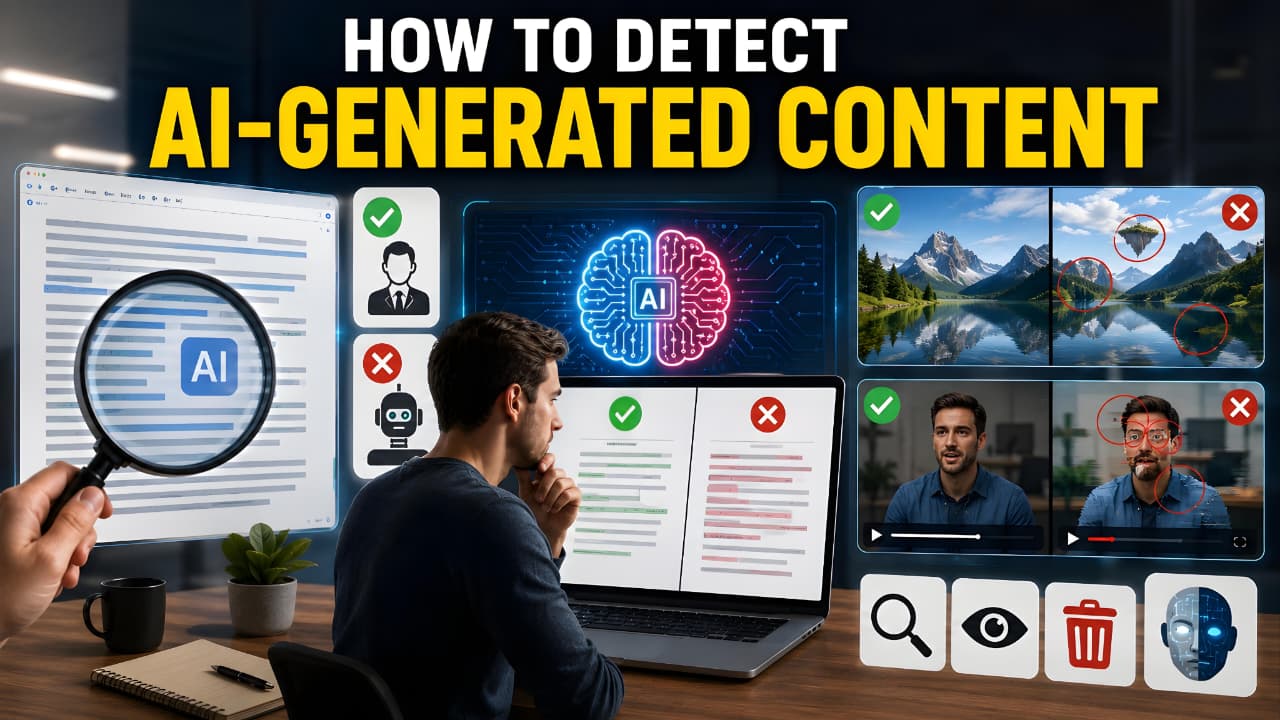
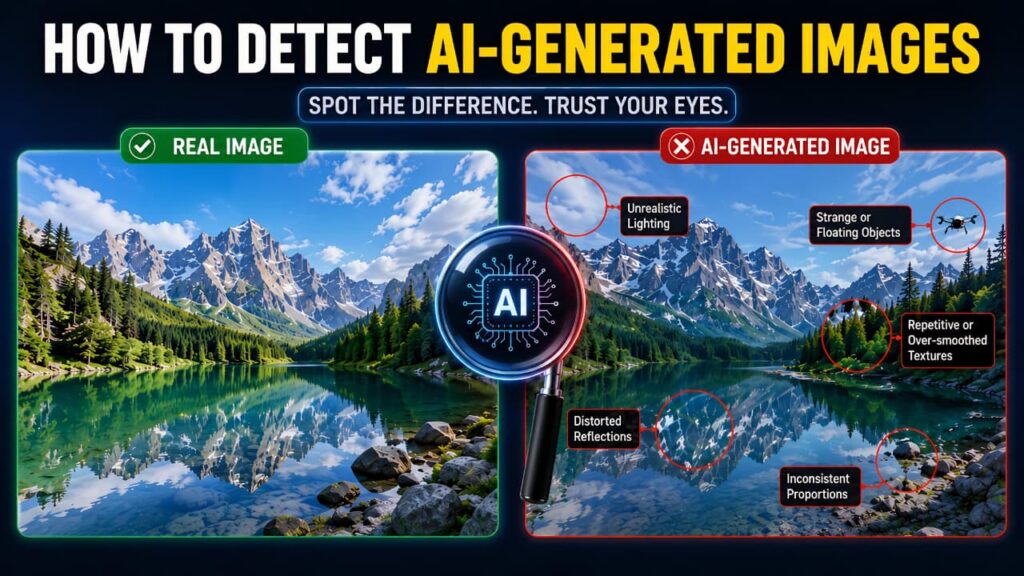
When discussing How to Detect AI-Generated Content, most people focus on text. However, AI-generated images have become equally common across social media platforms, websites, advertisements, and even news articles.
Modern image-generation tools can create highly realistic visuals that are often difficult to distinguish from real photographs. Despite their impressive quality, AI-generated images frequently contain subtle imperfections.
Here are some of the most common signs.
Look Closely at Hands and Fingers
For years, one of the easiest ways to identify AI-generated images has been by examining hands and fingers.
Although image-generation models continue to improve, AI may still produce:
- Extra fingers
- Missing fingers
- Unnatural hand positions
- Distorted finger shapes
- Incorrect finger proportions
Whenever you’re trying to determine How to Detect AI-Generated Content in image form, zooming into the hands is often a good starting point.
Check Eyes and Facial Features
AI-generated portraits can look remarkably realistic at first glance. However, small inconsistencies often appear when you inspect facial details more closely.
Look for:
- Uneven pupils
- Asymmetrical eyes
- Strange reflections
- Blurred teeth
- Distorted ears
These issues are becoming less common, but they still appear in many AI-generated images.
Examine Background Details
Many people focus entirely on the subject while ignoring the background.
This is a mistake.
Background elements often reveal important clues about How to Detect AI-Generated Content.
Common warning signs include:
- Warped buildings
- Floating objects
- Distorted furniture
- Unnatural shadows
- Inconsistent lighting
AI frequently struggles to maintain logical consistency across complex scenes.
Look for Unrealistic Text
One of the most reliable indicators of AI-generated images is inaccurate text rendering.
Signs include:
- Misspelled words
- Random letters
- Incomplete text
- Meaningless symbols
Although modern AI image generators have improved significantly, text remains a common weakness.
If a poster, signboard, product label, or banner contains strange lettering, it may indicate AI generation.
Readers interested in understanding the tools behind these images can explore Best Free AI Image Generators, which explains how modern AI image creation platforms work.
How to Detect AI-Generated Videos
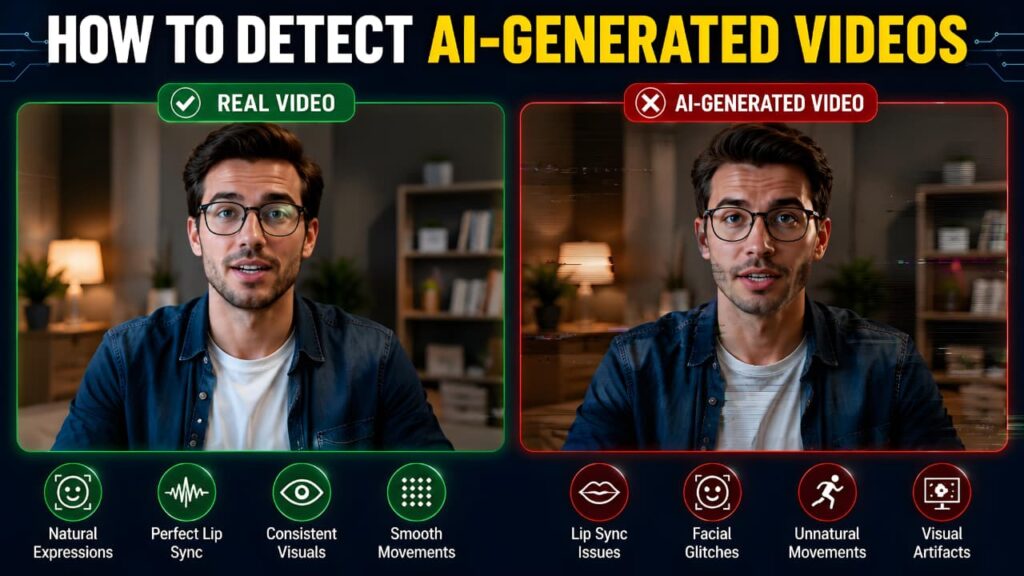
AI-generated videos are becoming increasingly sophisticated.
Today, AI can create:
- Talking avatars
- News presenters
- Product demonstrations
- Social media videos
- Promotional content
Learning How to Detect AI-Generated Content now requires understanding video analysis as well.
Watch Lip Synchronization
One of the most noticeable clues in AI-generated videos is imperfect lip synchronization.
Pay attention to:
- Delayed mouth movements
- Misaligned speech patterns
- Unnatural facial expressions
- Robotic timing
Even advanced AI video tools occasionally struggle to perfectly match speech with facial movement.
Observe Facial Expressions
Human emotions are complex and often subtle.
AI-generated videos may contain:
- Repetitive expressions
- Sudden emotional changes
- Frozen facial features
- Unnatural blinking
These issues become easier to spot during longer videos.
Check for Visual Flickering
Visual consistency remains a challenge for many AI video-generation systems.
Look for:
- Changing facial features
- Flickering backgrounds
- Inconsistent lighting
- Shifting objects
These artifacts often reveal that a video was generated or heavily modified using AI.
Analyze Voice Quality
Many AI-generated videos use synthetic voices.
Common indicators include:
- Unnatural pacing
- Robotic pronunciation
- Missing emotional variation
- Excessively smooth speech
However, modern AI voice systems are rapidly improving, making detection increasingly difficult.
How to Detect AI-Generated Content Using Human Judgment
Technology can help identify AI-generated material, but human judgment remains one of the most effective detection methods.
When evaluating content, ask yourself several key questions.
Does the Content Feel Generic?
One useful approach when learning How to Detect AI-Generated Content is to assess how specific the information feels.
AI-generated articles often:
- Stay broad
- Avoid strong opinions
- Provide limited unique insights
- Reuse common explanations
Human experts usually add:
- Personal observations
- Industry knowledge
- Real-world examples
- Practical recommendations
Does the Content Include Verifiable Sources?
Reliable content typically references trustworthy sources.
Check whether the author includes:
- Research studies
- Official documentation
- Government resources
- Expert interviews
The absence of supporting evidence does not automatically indicate AI usage, but it can reduce credibility.
Readers interested in responsible AI usage can explore AI Rules in India, which discusses emerging AI regulations and governance considerations.
Does the Content Demonstrate Expertise?
Experienced writers often include:
- Industry terminology
- Detailed explanations
- Practical examples
- Case studies
AI-generated content frequently explains concepts correctly but lacks the depth that comes from hands-on experience.
This distinction becomes increasingly important when evaluating educational, technical, medical, or financial information.
Common Myths About AI-Generated Content
Many misconceptions exist regarding How to Detect AI-Generated Content.
Let’s address some of the most common myths.
Myth 1: Perfect Grammar Means AI
This is false.
Professional writers, editors, journalists, and academics often produce content with excellent grammar.
Grammar alone cannot determine authorship.
Myth 2: AI Content Is Always Wrong
AI-generated content is not automatically inaccurate.
In many cases, AI can provide useful and factually correct information.
The real challenge is verifying whether the information is current, accurate, and properly sourced.
Myth 3: AI Detectors Are 100% Accurate
This is one of the biggest misconceptions.
According to Microsoft AI, AI-generated content detection remains an evolving field, and no system can guarantee perfect accuracy in every situation.
Different detectors often produce different results for the same piece of content.
Myth 4: Humans Can Always Spot AI Content
This is increasingly untrue.
Modern AI models can generate content that closely resembles professional human writing.
This is why understanding multiple detection methods is essential.
The Role of AI Tools in Modern Content Creation
It’s important to recognize that AI itself is not inherently good or bad.
Many businesses, students, educators, marketers, and creators use AI responsibly.
Popular use cases include:
- Research assistance
- Brainstorming
- Draft generation
- Content outlining
- Language improvement
Many people exploring AI writing capabilities start with Top Free AI Tools, which showcases various AI platforms available for different productivity tasks.
Similarly, students increasingly rely on Free AI Tools for Students to assist with research, organization, and learning workflows.
The goal should not be to avoid AI completely. Instead, the focus should be on understanding how AI is used and ensuring that human oversight remains part of the content creation process.
Advanced Techniques for Detecting AI-Generated Content
As AI systems continue to improve, advanced evaluation techniques are becoming increasingly important.
These include:
- Cross-checking facts
- Comparing writing styles
- Reviewing source quality
- Evaluating originality
- Verifying claims through independent research
Researchers continue to develop new methods for improving How to Detect AI-Generated Content, but no single solution currently provides perfect results.
This means that combining AI detection tools, human analysis, and critical thinking remains the most reliable approach.
The Future of AI Content Detection
The future of How to Detect AI-Generated Content will become increasingly complex as artificial intelligence continues to evolve.
Modern AI systems are already capable of generating content that closely resembles human writing. Future models will likely become even better at understanding context, tone, emotion, and writing style.
As a result, traditional detection methods may become less effective over time.
Several trends are expected to shape the future of AI content detection:
- Improved AI watermarking technologies
- Better content verification systems
- Advanced AI detection algorithms
- Stronger transparency requirements
- Increased focus on source credibility
Organizations around the world are actively researching ways to improve trust and authenticity in digital content. According to Google AI, transparency and responsible AI development will play an important role in helping users understand how AI-generated information is created and presented.
For content creators, the best long-term strategy is not simply learning How to Detect AI-Generated Content, but also understanding how AI can be used responsibly while maintaining originality, expertise, and trustworthiness.
Best Practices for Evaluating Online Content
Whether content is written by a human, generated by AI, or created using a combination of both, readers should evaluate information carefully.
Follow these best practices:
Verify Important Claims
Always check important facts using reliable sources.
Look for:
- Official documentation
- Government resources
- Academic research
- Industry experts
Compare Multiple Sources
Avoid relying on a single article.
Cross-check information across multiple trusted websites before accepting it as accurate.
Look for Author Expertise
Content written by experienced professionals often contains:
- Detailed explanations
- Practical examples
- Industry knowledge
- Original insights
These qualities can help distinguish high-quality content from generic content.
Prioritize Helpful Content
The most valuable content solves real problems, answers important questions, and provides practical guidance.
Whether AI-assisted or fully human-written, content should ultimately benefit readers.
Frequently Asked Questions (FAQ)
How can you tell if content is AI-generated?
Several indicators can help identify AI-generated content, including repetitive phrasing, overly predictable structure, generic explanations, lack of personal experience, limited emotional depth, and missing original insights. However, no single sign can guarantee that content was created by AI.
Are AI detection tools accurate?
AI detection tools can provide useful clues, but they are not 100% accurate. Different detectors often produce different results for the same content. Human review remains an important part of the evaluation process.
Why is it difficult to detect AI-generated content?
Modern AI models generate highly natural language that closely resembles human writing. As AI technology improves, distinguishing between human-written and AI-generated content becomes increasingly challenging.
Can AI-generated content rank on Google?
Google focuses primarily on content quality rather than how content is created. Helpful, accurate, trustworthy, and user-focused content can perform well in search results regardless of whether AI assisted in the creation process.
Understanding how search engines evaluate content quality is important for creators who use AI tools responsibly.
Can AI-generated content contain mistakes?
Yes. AI-generated content can sometimes include factual inaccuracies, outdated information, misunderstood context, or fabricated details. This is why fact-checking remains essential.
Is all AI-generated content bad?
No. AI can be a valuable tool for research assistance, brainstorming, drafting, and productivity. The quality of content depends on how the tool is used and whether human review and verification are involved.
What is the most reliable way to detect AI-generated content?
The most reliable approach combines multiple methods:
- Human review
- AI detection tools
- Fact verification
- Source evaluation
- Writing pattern analysis
Using several techniques together provides better results than relying on a single detection method.
Conclusion
Understanding How to Detect AI-Generated Content is becoming an increasingly important skill in today’s digital world. As artificial intelligence continues to transform content creation, readers must learn how to evaluate information critically and responsibly.
While AI-generated content can often appear professional and convincing, subtle indicators such as repetitive language, generic explanations, lack of personal experience, predictable structure, and limited originality can help reveal its origins.
At the same time, it is important to remember that AI detection is not always straightforward. Modern AI systems are improving rapidly, and no detection method currently guarantees perfect accuracy.
The most effective strategy for How to Detect AI-Generated Content is to combine critical thinking, source verification, writing analysis, and human judgment. By applying these techniques, readers can make more informed decisions, identify trustworthy information, and navigate the growing world of AI-generated content with greater confidence.
As AI technology evolves, the ability to evaluate authenticity will become just as important as the ability to find information itself.